


| Fact | Detail |
|---|---|
| Oldest documented trade period | Byzantine era, approximately 4th-7th century CE |
| Primary wood species | Olea europaea (European/Palestinian olive tree) |
| Main artisan villages | Bethlehem, Beit Sahour, Beit Jala |
| Wood harvest window | October-November (pruned branches and natural deadwood only) |
| Curing time before carving | Minimum 6 months; 12-18 months for substantial pieces |
| Main carved objects | Nativity sets, crosses, rosaries, Marian statues, prayer beads |
bethlehem olive wood from Bethlehem is hand-carved wood from Olea europaea trees grown in the terraced groves surrounding Bethlehem, Palestine, where artisan families have shaped it into crosses, nativity sets, and religious art for over 2,000 years.
📝 In This Article
- A nativity set is a collection of figurines depicting the birth of Jesus in Bethlehem, traditionally including Mary, Joseph, the infant Jesus, shepherds, and the three Magi.
- Why Olive Wood? The Material That Chose the Craftsmen
- When Did the Carving Actually Start? The Byzantine and Crusader Eras
- The Generations Who Kept the Craft Alive Through Every Disruption
- The Full Range of What Gets Carved
- From Pruned Branch to Finished Piece
- What Makes Bethlehem Different from the Rest of the Mediterranean
- What Keeps the Craft Going Now
- Quick Questions
A nativity set is a collection of figurines depicting the birth of Jesus in Bethlehem, traditionally including Mary, Joseph, the infant Jesus, shepherds, and the three Magi.
The Church of the Nativity in Bethlehem was consecrated in 333 CE. By the time Byzantine pilgrims were walking Star Street in the 5th century, there was already a market for carved devotional objects near Manger Square. Small crosses. Figures of the Virgin Mary. Simple beads strung for counting prayers.
That is where the history of olive wood carving in this city really begins, not with a single inventor or a royal decree, but with something simpler: supply meeting demand. There were olive trees on every terraced hillside around Bethlehem. There were pilgrims who needed something to carry home. And there were families who knew how to work with their hands.
Seventeen hundred years later, not much about that equation has changed.
Why Olive Wood? The Material That Chose the Craftsmen

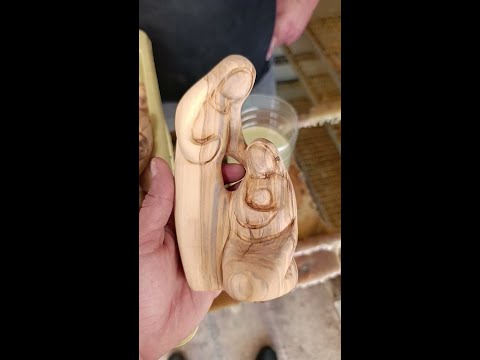
Before anyone picked up a chisel in Bethlehem, the olive trees were already here.
Olea europaea, the European olive tree, has been cultivated across the Mediterranean and Holy Land for over 6,000 years. On the hillsides around Bethlehem, some of the ancient trees are over a thousand years old, their trunks twisted and knotted into forms that look like they are mid-conversation with themselves.
The wood from these trees is genuinely remarkable as a carving material. It is dense, considerably harder than pine or cedar, which means it takes detail well and holds an edge for generations without wearing smooth. The grain runs in unpredictable waves and swirls, so every single piece is different. That natural variation is precisely why olive wood has a warmth that mass-produced alternatives simply cannot replicate. And when you cut it? There is a scent, sweet, slightly nutty, almost like toasted almonds. The smell in an active Bethlehem workshop is one of those things you do not forget.
One thing worth understanding upfront: olive wood carving here has never meant cutting down the trees. It never has. The craft uses pruned branches, the wood removed during olive harvest in October and November, plus any naturally fallen limbs. The living tree is far too valuable, both economically and culturally, to fell for timber. You work with what the tree gives you.
Understanding why this specific wood matters goes deeper than you might think, the olive tree's significance in scripture, its biology, and why aged wood from this region carves differently than olive wood grown elsewhere.
When Did the Carving Actually Start? The Byzantine and Crusader Eras

Red Rosary with Silver-Tone Chain – 47 cm – Lightly Scented Beads — View in store
Olive wood density ranges from 0.85 to 0.95 g/cm³, making it one of the hardest fruit woods. I am not a historian, but from what the elders in our community tell us, and from what archaeologists and Ottoman records have documented, the organized craft trade in Bethlehem began sometime in the Byzantine period, between the 4th and 7th centuries CE.
The completion of the Church of the Nativity under Emperor Constantine did not just mark a religious milestone. It turned Bethlehem into a pilgrimage destination, and pilgrimage destinations generate commerce. By the 5th century, the city had established markets for religious objects near Manger Square. Olive wood, readily available from the surrounding groves and already pruned each October by the same families who farmed it, was the obvious material for crosses, beads, and small figures of the Holy Family.
When the Crusaders arrived in the 11th century, they brought a wealthier European market with them, one hungry for Holy Land relics and devotional objects to carry back across the Mediterranean. Carvers in Bethlehem began producing more sophisticated work: multi-figure nativity scenes, detailed crucifixes, elaborately carved olive wood crosses.
The Mediterranean trade routes connecting Bethlehem to Venice, Genoa, and Spanish ports meant that by the 13th century, Bethlehem olive wood crafts were moving across the known Christian world.
That is the origin of what is now a global market. Every hand-carved piece on a mantelpiece in Ohio or in a parish church in Germany carries that lineage.
The Generations Who Kept the Craft Alive Through Every Disruption
🌱 From Our Bethlehem Workshop

Interested in seeing our collection? → Browse Nativities & Nativity Sets

Large Hand-Carved Olive Wood Nativity Scene from Bethlehem – Full Holy Family & Magi Set with Star — View in store
The Star of Bethlehem is depicted in over 90% of traditional nativity scenes worldwide. Here is what does not get said enough: this craft survived. Ottoman rule, British Mandate, regional conflicts, every generation of artisans in the Bethlehem area had reasons to stop. None of them did.
The knowledge passed from father to son, and increasingly from parent to child regardless of gender, in the family workshops of Bethlehem, Beit Sahour, and Beit Jala. These three neighboring towns form what you might loosely call the olive wood triangle of the Holy Land. Beit Sahour, just east of Bethlehem, is particularly known for nativity scenes. Beit Jala for larger carved figures. Bethlehem itself for the full range of devotional craftsmanship.
The family workshop structure meant that even when formal institutions could not support the trade, individual families sustained it. The olive trees kept being pruned each October. The wood kept curing through the winter. By December, the workshops were producing at full pace for the Christmas pilgrimage season.
| Era | Period | Regional Context | Impact on Carving Tradition |
|---|---|---|---|
| Byzantine | 4th-7th century CE | Church of the Nativity consecrated 333 CE; mass Christian pilgrimage begins | Cross and nativity carving formalizes as a pilgrimage trade; Beit Sahour families establish earliest workshops |
| Crusader | 11th-13th century | European pilgrims arrive with higher purchasing power; Mediterranean trade routes expand | Multi-figure nativity scenes develop; olive wood crosses begin reaching European churches via Venetian and Genoese traders |
| Ottoman | 1517-1917 | Bethlehem under Ottoman administration; pilgrimage continues | Family workshops sustain craft through four centuries; October harvest and December peak become the annual rhythm |
| British Mandate | 1917-1948 | Tourism infrastructure improves; postal trade opens | International catalog sales emerge; Palestinian artisans begin reaching customers in the Americas and Europe directly |
| Modern | 1948-present | Regional disruptions followed by internet commerce | Online orders become economic lifeline; artisan families in Beit Sahour and Beit Jala connect directly with global buyers; Zuluf founded 2007 |
The Ottoman period is particularly striking because it lasted four hundred years and is almost never discussed. The Ottomans were not Christian, but they were pragmatic administrators who understood that pilgrimage commerce was good for regional taxation. Bethlehem's artisan families continued their work for the entire Ottoman era without significant interruption. That kind of continuity, over four centuries, is part of why the craft runs so deep.
My daughter once asked why people so far away care about things we make here. I told her it's because they can feel where it comes from.
The Full Range of What Gets Carved

brown concrete statue of people — Photo by Eugenia Romanova on Unsplash
The tau cross (T-shaped) is one of the oldest cross forms, associated with St. Francis of Assisi. Walk into any working workshop near Manger Square and you will see the same paradox: ancient craft, genuinely global market. The same families who learned to make Byzantine-era crosses are now filling orders for Our Lady of Guadalupe statues destined for parishes in Mexico, rosaries for devotional communities in the Philippines, comfort crosses for hospice programs in Canada.
Nativity sets remain the signature product. Bethlehem is still the leading source of hand-carved nativity scenes in the world, and the quality varies enormously, from simple tourist-trade pieces to extraordinary multi-figure scenes with individually carved faces on each figure. Our collection of hand-carved wooden crosses and crucifixes reflects just one part of what the artisan families produce, from palm-sized holding crosses to larger wall-mounted pieces.
But the range is wider than many visitors realize. Carvers now produce Marian statues in every tradition, Our Lady of Guadalupe, Our Lady of Fatima, the Immaculate Conception, alongside Saint Michael figures, Saint Francis pieces, Angels, comfort crosses, rosary beads in multiple sizes, and decorative pieces that have no religious function at all.
The craftsmanship stays the same regardless of what is being made. Reading the grain before cutting, understanding how the dense olive wood heartwood will respond to a gouge, none of that changes because the finished form is different.
Our full Holy Land gifts collection includes pieces across these categories, each still made the way it has always been made. And if you are curious about the prayer tradition behind the rosary beads specifically, our interactive rosary prayer guide gives those objects real context.
From Pruned Branch to Finished Piece

10mm Oval Hand Carved Olive Wood Beads from Bethlehem — View in store
Olive wood is naturally antibacterial and resistant to decay, which is why ancient artifacts survive. October is harvest time.
The olive trees across the terraced hills around Bethlehem get their annual pruning back, and cut branches come into the workshops. This is when carvers stock their raw material for the coming year.
The wood cannot be carved immediately, it simply cannot. Fresh olive wood is still full of moisture, and if you shape it green, it will crack as it dries. The branches get cut into rough blanks and stacked to dry, typically for six months to a year for small pieces, twelve to eighteen months for anything substantial. The wood dries slowly in the Mediterranean air through the winter, the natural oils distributing through the piece, the grain setting.
Only after curing does carving begin in earnest. For hand work, it is chisel and mallet, knife and gouge.
The carver studies the grain before touching it, which way it runs, where the darker heartwood sits against the lighter sapwood, where the natural figure of the wood wants to go. That contrast between the cream sapwood and the darker honey-brown heartwood is the visual signature of authentic Bethlehem olive wood, and it cannot be mimicked in mass-produced alternatives.
If you are buying olive wood and want to verify a piece, our olive wood authenticity checker walks through every indicator, what to look for, what to feel, what the weight should be.
The olive trees pruned during the October-November harvest give excellent raw material for carving. Larger branches from naturally fallen trees occasionally supply material for bigger sculptural pieces. Nothing gets wasted. The character of olive wood, those irregular grain patterns that look almost like topographic maps, comes entirely from the age and growing conditions of each tree. You cannot manufacture that. You can only work with what the tree spent decades building.
What Makes Bethlehem Different from the Rest of the Mediterranean
Interested in seeing our collection? → Browse Wooden Crosses & Crucifixes

Olive Wood Nativity Scene from Bethlehem – Gypsum Holy Family Figures in Handcrafted Manger with Bark Roof — View in store
Olive wood naturally darkens with age, developing a richer honey-to-chocolate color over decades. Olive wood carving exists across the Mediterranean world. Calabria and Tuscany in Italy. Jaén in Spain. Crete and the Peloponnese in Greece. All of them have long traditions of working with Olea europaea.
But Bethlehem's craftsmanship is distinct in one fundamental way: almost everything carved here is devotional. The broader Mediterranean tradition leans heavily toward kitchenware, furniture accents, decorative bowls. Bethlehem artisans carved for pilgrims, which meant they carved for faith.
That focus created a specific kind of specialization in religious forms, the proportions of a nativity figure, the weight and balance of a hand-sized cross, the texture of prayer beads in the fingers. Palestinian artisans became practitioners of objects people hold while praying. That is a precise category of crafts, and it required generations to perfect.
UNESCO recognized Palestinian olive wood carving as intangible cultural heritage in 2019, acknowledging both its historical depth and its cultural distinctiveness, not just any Mediterranean handicraft tradition, but a specific craft with its own lineage, its own techniques, and its own irreplaceable community of practitioners.
What Keeps the Craft Going Now

8mm Round Hand made Olive Wood Beads from Bethlehem — View in store
In Bethlehem, olive wood is not just a craft, it is an economic lifeline. When tourism slows (and in the past two decades there have been stretches when it slowed to almost nothing), families depend on orders from people around the world who remember a visit to Bethlehem and want to bring something of it home. The internet changed the geography of that relationship completely. A carver in Beit Sahour can now fill an order for a family in Minnesota or a church in Germany without either side ever meeting.
You can tell a lot about a carver by looking at their hands. The calluses, the small nicks, that one finger that no longer quite straightens. It is a map of every nativity set, every cross, every rosary bead they have ever shaped. Those hands represent a line of knowledge that runs back to Byzantine pilgrims arriving in the 4th century and placing their first order for something to carry home.
That resilience, maintaining the craft and the faith through every kind of disruption, is something we have written about before, and it is worth reading alongside the history.
We at Zuluf have been part of this modern chapter since 2007. We are not the story, the artisan families of Bethlehem, Beit Sahour, and Beit Jala are the story. But we try to be a reliable connection between the work happening in these workshops and the people who genuinely want it.
The tradition is alive.
October harvest still comes. The wood still cures through winter. The lathes still run on Star Street, and the chisels still cut into that sweet-smelling olive wood grain.
If you want to understand how that journey from workshop to your home actually works, that is worth reading too.
Quick Questions

A central display column hung with red beaded rosaries, packaged carved crosses, and rows of round magnets, with shelves of olive wood carvings on either side and boxed nativity sets stacked on the floor.
How long has Bethlehem been carving olive wood?
At least 1,700 years, with the craft's commercial origins in Byzantine-era pilgrimage trade from the 4th century CE onward. The Church of the Nativity's consecration in 333 CE is the anchor point, it turned Bethlehem into a pilgrimage destination and created demand for devotional objects carved from the abundant local olive wood.
Who started olive wood carving in Bethlehem?
No single founder exists. The craft emerged from the intersection of two things that were already present: olive trees, pruned each October across the terraced hillsides, and Christian pilgrims who needed something to carry home. It was a community response across multiple artisan families, not an individual invention, and those families, particularly in Beit Sahour and Beit Jala, have sustained it ever since.
How many families in Bethlehem carve olive wood?
Several hundred artisan families across Bethlehem, Beit Sahour, and Beit Jala are involved in olive wood carving at various scales. The number fluctuates with tourism and regional conditions, but the craft base has remained remarkably stable across generations because it is passed through family workshops rather than formal institutions.
Why is Bethlehem important in Christianity?
Bethlehem is the birthplace of Jesus, documented in both the Gospel of Matthew and the Gospel of Luke. The Church of the Nativity, built on the site of the traditional manger and consecrated in 333 CE, is one of the oldest continuously operating Christian churches in the world. The city draws Christian pilgrims from across the world, second in significance only to Jerusalem.
What is the difference between a cross and a crucifix?
A cross is the geometric form alone, the intersecting horizontal and vertical beams, without any figure attached. A crucifix includes the corpus: the carved figure of Christ on the cross. Both forms are deeply rooted in Christian tradition. In Bethlehem, artisans carve both; the crucifix requires considerably more skill to execute well in olive wood, as the figure's proportions must read clearly even at small scale.
How do you know if olive wood is authentic?
Look for the natural color variation within a single piece, genuine olive wood shifts from pale cream sapwood to darker honey-brown heartwood, often in the same object. The grain should be irregular and flowing, not uniform. Authentic pieces have a slight warmth and weight to them that machine-carved imports rarely match. Our olive wood authenticity guide covers every indicator in detail.
When you are buying olive wood, look for the dark swirling grain lines, that is the heartwood, and it develops only in trees that are at least fifty to a hundred years old. The more pronounced the contrast between the pale cream and the dark amber, the older and denser the wood. That is not just an aesthetic marker. It is the signature of a tree that spent decades on those terraced hillsides outside Bethlehem, giving the Mediterranean sun and limestone soil time to work their way into every fiber.
That is what you are holding.

Elias Zuluf is the founder of Zuluf (est. 2007), one of the largest olive wood factories in Bethlehem and the Holy Land. Winner of the Palestine Exporter of the Year Award 2017. Partners with 20+ Christian artisan families to handcraft authentic olive wood crosses, nativity sets, rosaries, and religious gifts shipped to 30+ countries worldwide.


